Your data pipeline may work perfectly. Your dashboards are updated, your AI models are running, and your reports are ready. But if a sensitive data field changes somewhere along the way, can you trace every downstream asset that depends on it?
For organizations using both Snowflake and Databricks, answering this question can be surprisingly difficult. Data moves between warehouses, lakehouses, transformation layers, analytics tools, and AI workloads. Yet lineage visibility often remains limited to individual platforms.
The result? Teams may understand what happens inside each system without seeing the complete journey between them.
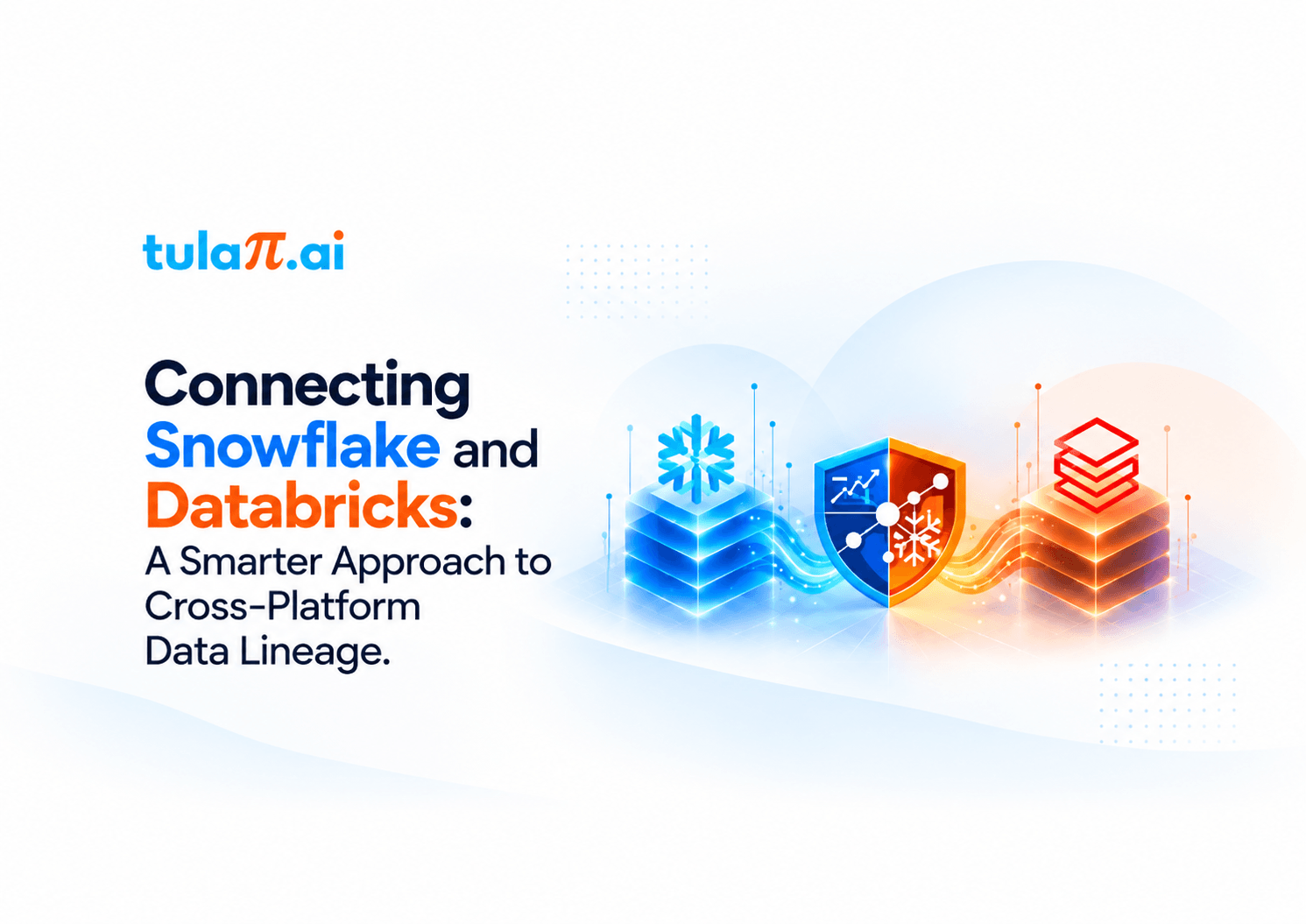
Cross-platform data lineage connects these separate views, helping organizations understand where data originates, how it changes, and what depends on it across the wider ecosystem.
Tulapi.ai brings lineage and governance capabilities together to help teams move beyond isolated data views and make more informed decisions about their data.
Why Cross-Platform Data Lineage Matters
Snowflake and Databricks serve different but often complementary purposes. Snowflake supports enterprise data warehousing, governed data access, and analytics, while Databricks supports lakehouse processing, advanced transformations, machine learning, and AI.
In a typical architecture, data may originate in Snowflake, enter Databricks for transformation, pass through Bronze, Silver, and Gold layers, and eventually power business intelligence dashboards or machine learning models.
Native lineage helps explain dependencies within individual platforms. However, when data crosses platform boundaries, teams need to connect those relationships to understand the complete flow.
Without this connected view, organizations can face:
- Incomplete impact analysis: Identifying all downstream dependencies before changing a source table or column becomes more difficult.
- Governance blind spots: Sensitive data may move between environments without a clear, connected view of its classification and protection.
- Longer troubleshooting cycles: Engineers may need to investigate multiple systems to identify the source of a data quality issue.
- Fragmented accountability: Ownership and stewardship responsibilities can become harder to establish across distributed data pipelines.
The challenge is not simply tracking data movement. It is understanding the operational and governance implications of that movement.
How Tulapi.ai Connects Snowflake and Databricks
Consider a Snowflake dataset that is exposed to Databricks through a Unity Catalog foreign catalog. Databricks then uses the Snowflake-backed source in a transformation pipeline, creating a relationship that crosses the platform boundary.
From there, lineage can continue through Databricks processing layers.
A representative workflow looks like this:
Snowflake source → Databricks Bronze → Silver → Gold → Analytics and AI
For example, a product dataset might move through the following assets:
- Snowflake source:
snowflake_direct_catalog_new.northwind2.products - Bronze layer:
tulapi_demo.bronze.products_raw - Silver layer:
tulapi_demo.silver.products_clean - Gold layer:
tulapi_demo.gold.products
Tulapi.ai connects the available cross-platform relationship with lineage evidence from downstream transformations, helping teams understand the data journey as a connected graph.
This approach complements native lineage rather than replacing it. The objective is to connect available evidence across platforms and provide a more complete view of dependencies.
Want to connect lineage with governance across Snowflake and Databricks? Explore the Tulapi.ai Data Governance Command Center to discover how data lineage, classification, access control, data protection, and other governance capabilities can help your team gain greater visibility and control across the data lifecycle.
Why Column-Level Lineage Makes a Difference
Table-level lineage provides a useful overview of how datasets depend on one another. However, many governance decisions require a more precise understanding of individual fields.
Consider customer data moving between Snowflake and Databricks.
A sensitive EMAIL field may originate in a Snowflake customer table, while Databricks also receives customer records from operational sources. The records are combined and standardized into a curated customer profile, where the email field becomes CONTACT_EMAIL.
That curated dataset may then feed a marketing audience, a customer support dashboard, and a churn prediction model.
If the original email field changes, table-level lineage may identify the affected customer dataset. Column-level lineage, where supported by the available metadata, can help trace the field through transformations and identify downstream consumers.
This visibility supports more precise impact analysis, reduces manual investigation, and helps teams understand where sensitive information travels.
Explore Tulapi.ai’s Data Lineage capabilities to learn how upstream, downstream, and column-level lineage can support better data change decisions.
From Lineage to Complete Data Governance
Lineage explains how data moves. Governance helps determine whether that movement is appropriate, controlled, and trustworthy.
Tulapi.ai’s Data Governance Command Center brings together multiple governance capabilities within a Snowflake-native workspace.
1. Data Classification and Object Tagging
Discover sensitive data in tables and views, organize classification profiles, apply recommended system tags, and establish consistent metadata through governed object and column tags. Tag-based policy binding can also connect classification with data protection controls.
2. Access Control and Data Protection
Review users, roles, grants, and object privileges to support least-privilege access. Apply native Snowflake protection policies, including masking and row access policies, to help control how sensitive data is accessed and used.
3. Data Stewardship and Accountability
Connect classified data with responsible stewards and access approvers. Clear ownership helps governance teams establish accountability and route decisions to the appropriate people.
4. Data Quality Monitoring
Define data quality expectations, schedule measurements, and review pass/fail results through a monitoring interface. Combined with lineage, quality insights can help teams investigate problems and understand potential downstream impact.
5. Trust Center and Security
Review security findings, scanner coverage, sensitive-data controls, authentication readiness, and AI security posture. This provides additional context for prioritizing governance and security improvements.
6. Network, Authentication, and Secure Data Sharing
Manage network rules, multifactor authentication policies, and relevant account security controls. Govern data sharing through secure views, approved objects, consumer accounts, and controlled sharing workflows.
7. AI Governance
Manage role-based access to Snowflake AI capabilities, including Cortex-related privileges, and use allowed tags to constrain AI-enabled data access.
Together, these capabilities help connect technical visibility with the controls and accountability required for effective governance.
Who Benefits from Connected Lineage?
Cross-platform lineage supports teams across the data lifecycle.
- Data engineers can trace dependencies, investigate pipeline issues, and assess changes before implementation.
- Data architects can understand data movement across warehouse and lakehouse environments.
- Governance leaders can connect lineage with classification, ownership, protection, and quality.
- Security teams can review access, sensitive-data controls, and potential exposure.
- Analytics and AI teams can better understand the origins and transformation history of the datasets powering their workloads.
A connected view helps these teams work from a shared understanding of data dependencies rather than reconstructing the journey separately.
Build a More Connected Data Governance Strategy
As data architectures become increasingly distributed, governance must extend beyond individual platforms.
Snowflake and Databricks each provide valuable native lineage capabilities. Connecting available lineage evidence across their boundaries helps organizations build a more complete picture of data dependencies, while governance controls provide the context needed to act on that information.
Tulapi.ai combines lineage with capabilities spanning classification, access control, protection, stewardship, data quality, security, secure sharing, and AI governance.
The goal is simple: help teams understand not just where their data moves, but what that movement means for trust, security, and business outcomes.
Follow the data, not the platform boundary.