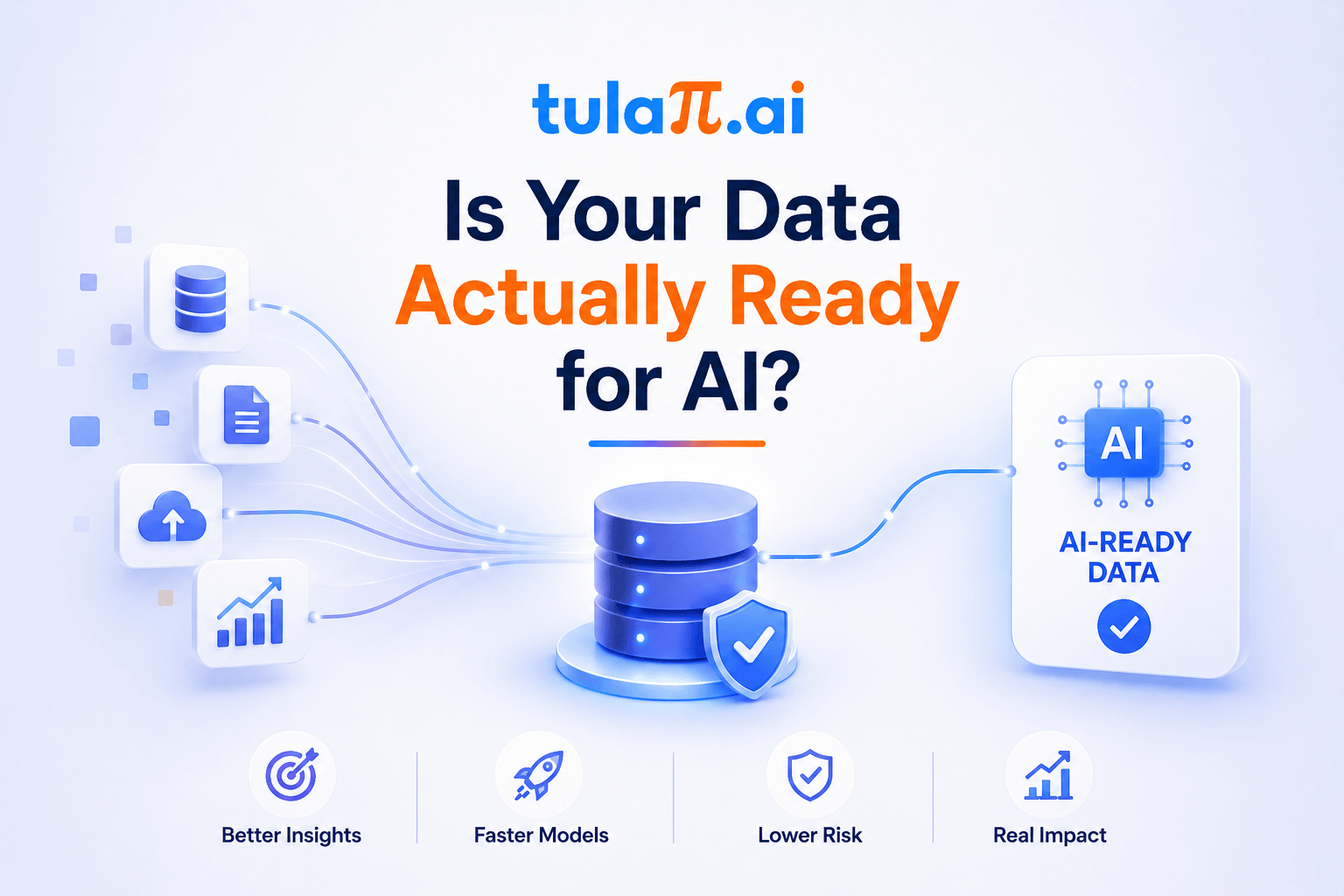
Most teams assume that because they have dashboards, warehouses, and a “data strategy”, they are ready for AI. In reality, AI is the fastest way to expose years of ignored data debt—missing fields, conflicting metrics, and brittle pipelines that quietly break models in production.
AI does not sit “on top of” your existing data; it stress‑tests every weakness. When foundations are weak, pilots look impressive, but real projects stall, burn budget, and erode trust across the business.
What “AI‑Ready Data” Really Means ?
AI‑ready data is not “we loaded it into Snowflake” or “we added some quality checks”. It is a state where your critical data is:
- Consistent: The same KPI means the same thing in sales, finance, and operations—no reconciliation meetings, no version‑of‑the‑truth debates.
- Accessible: Data practitioners can find and use governed, documented datasets in minutes, instead of waiting weeks for tickets and ad‑hoc extracts.
- Governed: Lineage, ownership, and policies are explicit, so security and compliance questions have clear, auditable answers.
- Reliable at scale: Pipelines and platforms handle training, batch scoring, and real‑time inference without crashing under volume or complexity.
This is the difference between “we can build a proof‑of‑concept notebook” and “we can safely run AI in production across the company”.
Why Data Understanding Must Come First ?
Jumping straight into model building without deeply understanding your data almost guarantees failure. Industry studies show that most AI initiatives fail not because of algorithms, but because teams skip basic questions about distributions, outliers, and business meaning.
Everyday examples look like this: a retailer forecasting demand without accounting for regional and seasonal patterns in transactions; a churn model trained on records with silent nulls in key demographic fields; a pricing model fed by inconsistent product hierarchies from multiple ERPs. What was “good enough for BI” becomes dangerous when AI uses it to automate decisions.
To avoid this, data understanding needs to be a mandatory first gate: profile fields for anomalies and completeness, map datasets directly to business outcomes, and identify the features that truly matter before any modeling begins.
Clear Signs Your Data Is Not AI‑Ready
You do not need a long workshop to know the data is not ready for serious AI. A few simple checks usually tell the story:
- Different teams quote different numbers for the same KPI in the same meeting.
- Critical reports still depend on last‑minute Excel fixes before they go to leadership.
- When a model output looks wrong, no one can easily trace which tables and transformations produced the inputs.
- Important data is scattered across CRMs, marketing platforms, legacy marts, and spreadsheets with no clear ownership.
AI will not fix these problems. It will make them louder, faster, and more expensive.
Why AI Built on Weak Data Breaks ?
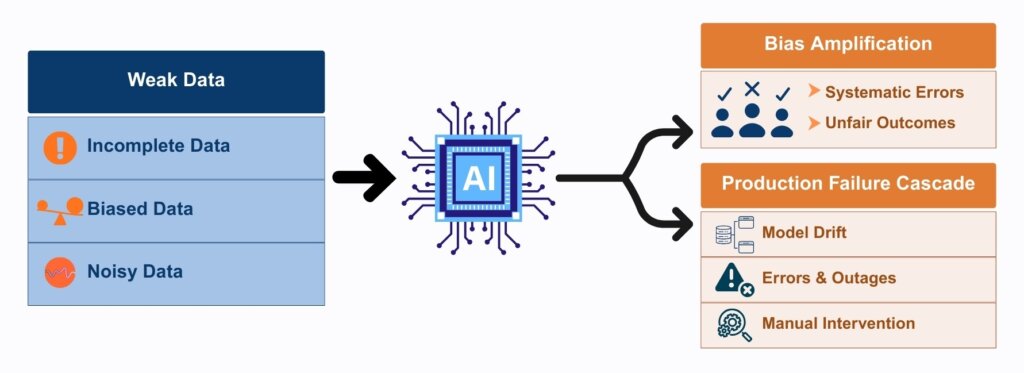
AI systems are unforgiving. They magnify small biases into systemic errors, and they amplify minor inconsistencies into major outages. In production, unreliable data leads to model drift, frequent manual interventions, and “mysterious” behavior that destroys business confidence.
Once leaders see predictions flop a few times, they stop funding AI, even if the underlying issue is data quality, not the idea. Studies consistently show that data issues cause the majority of AI stalls—far more than model choice or talent gaps.
How Snowflake Provides the Foundation ?
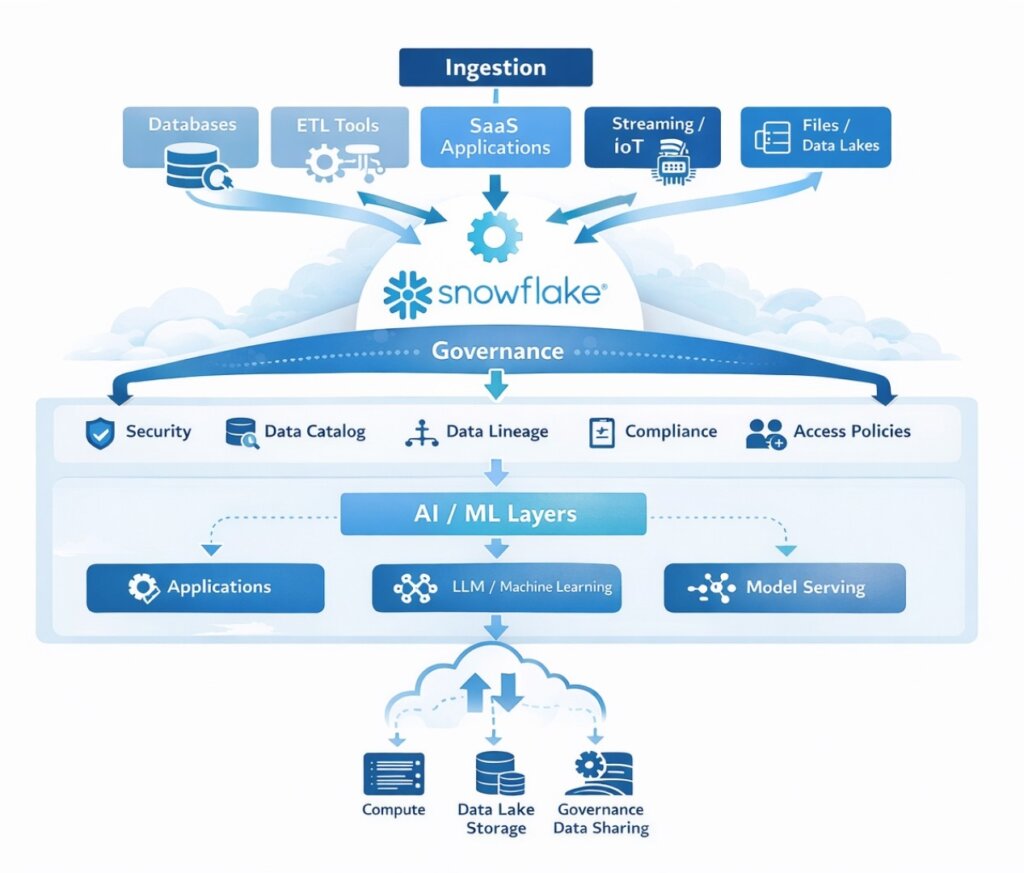
Snowflake offers a centralized, scalable foundation for both analytics and AI workloads. Its architecture separates storage from compute, so you can efficiently handle everything from daily reporting to petabyte‑scale model training.
Built‑in governance capabilities—like lineage tracking, dynamic masking, and row‑level security—help enforce policy and compliance, while performance optimizations support low‑latency inference. This allows teams to unify silos into a governed lakehouse that is ready for feature engineering, vector search, and ML pipelines.
Snowflake‑Powered AI Readiness
| Layer | Components | Benefits |
| Ingestion | Openflow, Kafka connectors | Real‑time capture from operational systems |
| Storage | Multi‑cluster warehouses | Elastic scale and zero‑copy data sharing |
| Governance | Dynamic masking, row‑level security | Built‑in compliance and trust |
| AI/ML | Cortex AI, external ML functions | In‑platform training and inference |
| Observability | Query history, resource monitors | End‑to‑end visibility into pipelines |
How Tulapi Makes You AI‑Ready ?
Tulapi focuses on making your data safe and reliable for AI—not just shipping a flashy proof of concept.
- Assessment: A 360° audit of your data health across consistency, accessibility, governance, and reliability, with a clear scorecard and prioritized gaps.
- Architecture: A pragmatic target design that connects your sources to Snowflake and structures data products for both analytics and AI use cases.
- Implementation: Robust ingestion, quality checks, governance, and observability so your feature tables, training sets, and vector stores stay trustworthy over time.
- Adoption: Phased AI rollouts on top of clean, well‑understood data—starting with narrow, high‑value use cases that prove ROI and build internal confidence.
The result is not just “Snowflake deployed” or “an AI pilot in a slide deck”. It is a repeatable, governed data foundation that lets you scale from one successful AI project to an entire portfolio of AI‑powered products.
Take the First Step
AI readiness is not a one‑time checklist—it is an ongoing investment in the quality, governance, and reliability of your data. Weak foundations guarantee breakdowns; strong foundations turn AI into a durable, compounding advantage.
If you want to understand where you stand today, start with Tulapi’s Data Assessment.
Book a free audit to benchmark your current state and get a concrete roadmap to AI‑ready data.