(And How Organizations That Win Actually Build AI)
Enterprises today are not short on AI pilots. They are short on AI systems that carry real revenue, risk, or operational responsibility.
Decks look impressive, PoCs hit their accuracy targets, and then everything stalls the moment the model is asked to run every day, on real data, for real users. The pattern is consistent: the model “works”, but the environment it depends on does not—fragmented data, brittle pipelines, no clear owner, and zero plan for how decisions will actually change.
This is not a technology problem. It is a structural and organizational one.
AI Spend Is Up. Production Success Is Not.
Industry after industry reports the same outcome: only a small fraction of AI initiatives transition from pilot to stable, long-term deployment. The failures do not show up in the lab. They appear exactly when AI must:
- Ingest production-scale, messy, frequently changing data
- Integrate with live operational systems and SLAs
- Take responsibility for real decisions with real consequences
Most organizations over-invest in the “demo layer” and dramatically under-invest in the operating discipline required after the first release.
Four Structural Reasons AI Projects Fail
1. Data Foundations That Collapse Under Pressure
Trying to run AI on contradictory, scattered data is like building a skyscraper on sand.
Typical symptoms:
- Revenue, margin, or churn numbers do not match across systems
- The PoC data came from “that one clean table” no one uses in production
- No single, governed source of truth for the features that matter
In one retailer, a pricing model behaved “erratically” only in production. The root cause: each region sourced inputs from a different system, each with its own logic and timing. The model was consistent; the data reality was not.
Without a strong data foundation, even the best-engineered models lose credibility quickly. And once credibility is gone, the project is already lost.
2. AI Without a Decision Owner
Too many initiatives start with “let’s build a churn model” instead of “let’s redesign how we retain at-risk customers, and who does what when.”
That leads to:
- PoCs that answer “can we predict this?” but never define who will act, how, and when
- Accuracy celebrated; adoption ignored
- A silent gap between analytics, marketing, sales, and operations
In one financial services company, a churn prediction model showed excellent accuracy in the PoC. It was never used. Marketing assumed sales would follow up. Sales assumed analytics would embed it in CRM workflows. No one had explicit accountability for the decision, so a technically successful model never left the lab.
If no one owns the decision, no one will own the AI.
The cost is high: months of sunk effort, political capital spent with skeptical executives, and talented engineers who now avoid AI projects because “they never ship.”
3. Pipelines Held Together by Favors and Notebooks
Many AI pilots are powered by:
- One-off SQL scripts
- Unversioned notebooks
- Manual data exports at 11:55 p.m. before the steering committee
- Spreadsheet-based “reconciliation” between systems
That is acceptable for discovery. It is catastrophic for production. As data volume and use cases grow, engineering teams get trapped in constant firefighting—fixing broken jobs, re-running backfills, hand-patching data. Stakeholders conclude “AI is unreliable”, and the project quietly stalls.
4. No Governance Once the Model Goes Live
Even the best-built system will drift out of shape if nobody watches it. Typical missing pieces:
- No monitoring for data drift, concept drift, or performance decay
- No clear run-book for retraining, rollback, or incident response
- No single team mandated to ask “is this model still fit for purpose?”
The result: a model calibrated for last year’s behavior slowly degrades. Nobody can explain why results feel “off.” Usage erodes. The project is quietly shelved.
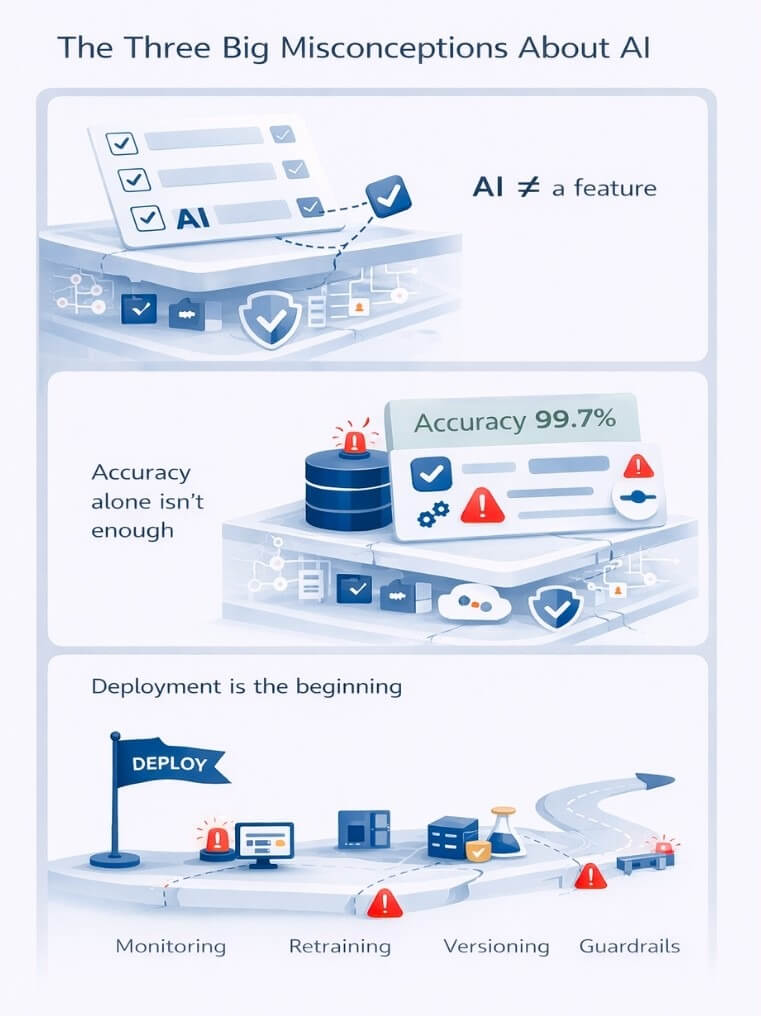
The Three Big Misconceptions About AI
1. “AI is a feature we can add at the end.”
In reality, AI is a system: data infrastructure, governance, processes, and people. Treat it like a checkbox on a roadmap, and you get a demo—never a dependable service.
2. “If the model is accurate, we’re done.”
Accuracy is necessary but meaningless without reliability, observability, and integration into real workflows.
3. “Once deployed, the hard work is over.”
Deployment is the starting line. The hard work—monitoring, retraining, versioning, guardrails, change management—is just beginning.
The Hidden Cost of Failed AI
Failed AI is not just “a learning experience.” It creates very real drag:
- Political cost: Leaders get burned and become conservative on future AI bets. One failed multi-million-dollar initiative makes the next one three times harder to fund.
- Talent cost: Strong engineers and data scientists do not want to work on initiatives that never leave the PoC phase. You lose institutional AI capability.
- Opportunity cost: Competitors who operationalize AI compound advantages quietly while you keep “experimenting”. By the time you realize the gap, it is much harder to close.
A typical failed AI project costs 6–12 months of sunk effort, ties up 4–8 engineers, and sets organizational AI confidence back by years.
What Production-Grade AI Actually Looks Like
Organizations that consistently succeed with AI treat it like any other critical production system—only with higher uncertainty and faster change.
1. Architecture Built for Growth, not a Single PoC
They invest in:
- A central, governed data platform (e.g., Snowflake) instead of scattered marts and exports
- Shared feature definitions between training and serving, to avoid “two versions of reality”
- Lineage and documentation so changes are traceable end-to-end
The goal: every new AI use case gets easier, not harder. Your second model should be faster than your first.
2. Explicit Contracts Between Business and Engineering
Before a single model is trained, successful teams answer:
- Which decision are we changing?
- Who owns that decision in business?
- What does “good” look like in production (not just in a Jupyter notebook)?
Post-launch, business and engineering own the system together: one accountable for outcomes, one for reliability.
3. Model Lifecycle Management as a First-Class Discipline
In mature teams, nobody asks “what is live right now?”—because it is obvious:
- Every model is versioned and tied to specific datasets and feature sets
- Promotion from dev → staging → prod follows a defined path
- Benchmarks across versions are recorded and comparable
- Rollback is a button, not a war room
This is basic software engineering applied to AI. Most organizations skip it.
4. Human in the Loop by Design, Not as a Patch
High-stakes systems are not launched as fully autonomous black boxes. They are rolled out with:
- Confidence thresholds that trigger human review
- Escalation paths for edge cases
- Clear guidance on when humans can override and why
Over time, as trust is earned and patterns stabilize, automation ratchets up—without putting the business at unnecessary risk.
Maturity is measured by how much humans choose to delegate, not how much they can.
AI Readiness Checklist
Before greenlighting your next AI initiative, ask:
- Is there a named business owner for the decision this model will influence?
- Is the primary data source in a governed platform, or are you still relying on ad-hoc extracts?
- Is there an agreed SLO (latency, freshness, uptime) for this system?
- Is monitoring for drift and data quality defined before deployment?
- Is there a human-in-the-loop / override plan for the first 3–6 months?
- Do you have a rollback plan if the model underperforms in production?
- Is there a named owner accountable for this system 12 months after launch?
If you answer “no” to more than two of these, you are not ready for production. Go back to architecture.
The Tiers of AI Maturity
Most organizations try to jump from Tier 0 to Tier 3 in one step. That is why things break.
Tier 0: Experiment
- Notebooks, ad-hoc data, no SLAs
- Goal: can we build this?
Tier 1: Assisted Decisions
- Humans in full control; AI as recommendation input
- Model output is reviewed before any action
- Goal: prove value and build confidence
Tier 2: Shared Control
- AI executes within guardrails; humans handle exceptions
- Monitoring and rollback are active
- Goal: scale while maintaining safety
Tier 3: Delegated Automation
- AI operates autonomously under clear policy and monitoring
- Humans remain notified and can intervene
- Goal: reliability and efficiency at scale
Successful organizations spend time in each tier, not months—but they do not skip them.
The Shadow AI Problem
Many teams quietly wire models or SaaS AI features into critical workflows without:
- Central visibility
- Data governance review
- Security / compliance sign-off
That “shadow AI” often works fine until it does not. Then you discover a model making decisions for thousands of customers, and nobody knows:
- What data it uses
- How often it is updated
- Who maintains it
- What the business impact is if it fails
This is not a compliance headache; it is a business continuity risk.
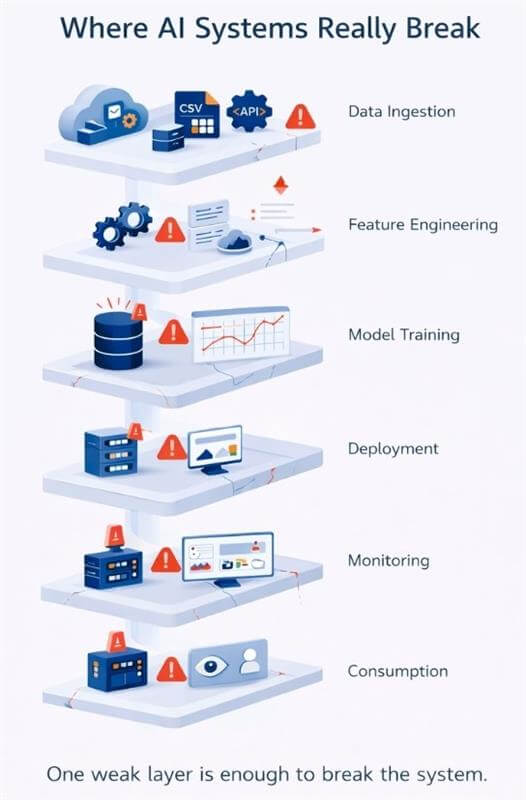
Where AI Systems Really Break
Most breakdowns are not mysterious. They happen in predictable layers:
| Layer | Typical Failure Mode |
| Data ingestion | Silent schema changes, source outages, late data |
| Feature engineering | Training–serving skew, undeclared assumptions |
| Model training | Overfitting to a static snapshot of the past |
| Deployment | Ad-hoc releases, no rollback, no blue/green strategy |
| Monitoring | No drift detection, no alerting, no SLOs |
| Consumption | Insights not wired into tools or processes people use |
When any one of these is weak, the system will eventually fail—often before anyone has time to react.
Three Non-Negotiable Principles for Production AI
Organizations that win apply these principles relentlessly:
Principle 1: No model in production without a named decision owner.
Not a team. A person. Someone who wakes up knowing they are accountable for this system’s outcomes.
Principle 2: No PoC on data flows we cannot support in production.
If the data comes from a one-off export or a manual process, do not build the PoC on it. Rebuild the data layer first.
Principle 3: No deployment without a rollback plan and monitoring.
If you cannot undo a bad release in 15 minutes, and if you cannot see what is happening right now, you are not ready to ship.
How Tulapi Builds AI That Survives
Tulapi’s MANTRA is simple: if a system cannot survive in production, it does not count as success.
The approach focuses on:
- Outcome first: Define the decision, owner, and business metric before choosing an algorithm. Get that right, and the model follows naturally. Get that wrong, and no model will help.
- Data and architecture before models: Fix fragmentation, standardize features, and design for scale and governance upfront. This is not glamorous, but it is where the real work happens.
- Production from day zero: Versioning, monitoring, lifecycle management, and human-in-the-loop patterns are part of the initial design, not a Phase 3 wish list.
- Operating discipline, not one-off heroics: Build systems your teams can run on Monday morning, not systems that require the one person who built them to explain how they work.
The result: AI that moves beyond experimentation into reliable, accountable, and observable systems embedded in how the business actually runs.
Final Takeaway
AI does not fail because it is “too advanced”. It fails because it is treated as a one-off experiment instead of a living system that must operate reliably in real conditions.
In production, AI becomes part of daily decisions, customer experience, and core operations. That demands:
- Model lifecycle management with clear versioning and rollbacks
- Governance and monitoring for data quality and drift
- Human accountability and intervention paths
- Fail-safe design that can survive change and maintain trust
The organizations that win are not just training smarter models. They are building systems that can adapt, scale responsibly, and earn long-term trust.
Before you launch your next AI initiative, step back and ask:
- Can we trace, monitor, and roll back our models when conditions change?
- Do humans remain accountable when decisions carry real business impact?
- Is this system designed to adapt over time—or just to impress in a demo?
Because production AI is not about building the smartest model. It is about building systems that can survive change, scale responsibly, and earn long-term trust.
And that is an operating discipline—not an experiment.

Start With the Right Foundations
If you want to understand where your organization stands today—and what production-ready AI actually looks like for your specific situation—Tulapi can help.
We start with a rigorous assessment of your data architecture, governance, and operational readiness. Then we design a path that takes you from pilot to production in stages, with clear milestones and measurable outcomes.
Book a consultation with Tulapi today. Let us help you build AI that survives the real world.