There was a time—not very long ago—when building a “modern data stack” felt like assembling a high-performance machine.
Pick the best warehouse.
Add a fast ingestion tool.
Layer in transformation, orchestration, BI, and maybe some streaming.
If it all connected, you were done.
At least, that’s what we thought.
The Reality Check
Fast forward to 2026, and most teams already have what used to be considered “modern.”
- Cloud data warehouses are standard
- ELT pipelines are everywhere
- Dashboards are abundant
And yet, a surprising number of organizations are still asking the same question:
“Why don’t we trust our data?”
This is where the real story begins.
Because the modern data stack didn’t fail—it grew up.
Phase 1: The Tooling Era (What Got Us Here)
In the early wave of modernization, success was defined by adoption.
More tools meant more capability:
- Faster ingestion
- Scalable transformations
- Real-time possibilities
Teams proudly showcased architectures like this:
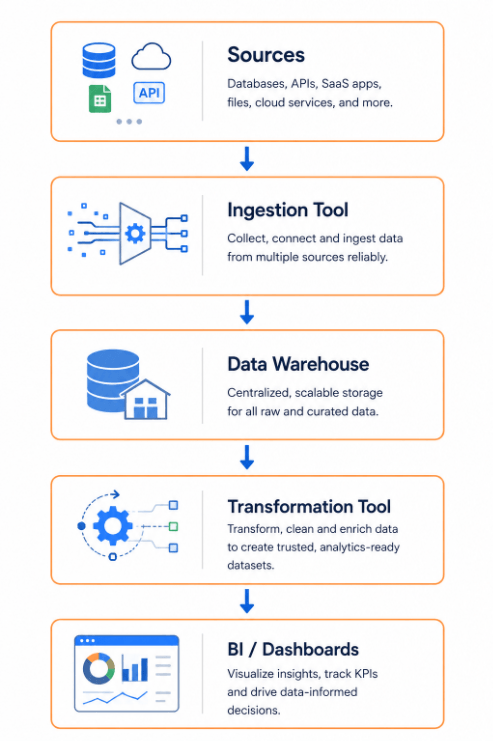
It worked—at least initially.
But as systems scaled, cracks began to show:
- Pipelines became fragile
- Debugging required jumping across tools
- Ownership became unclear
The stack was “modern.”
But it wasn’t resilient.
Phase 2: The Complexity Trap
As new needs emerged, teams responded the only way they knew how:
Add more tools.
Streaming engines.
Data quality platforms.
Catalogs.
Reverse ETL.
Feature stores.
The architecture evolved into something like this:
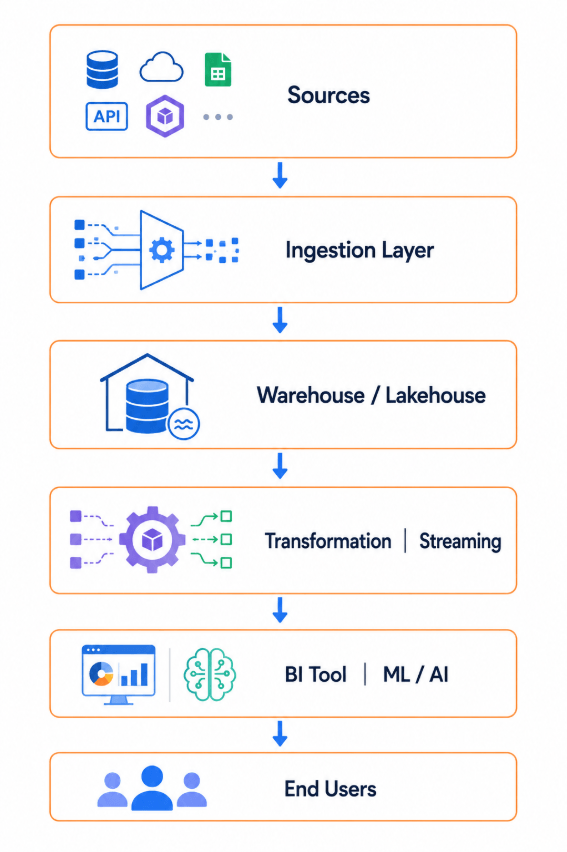
On paper, this looked powerful.
In reality, it introduced:
- More failure points
- Higher costs
- Slower debugging cycles
Teams started spending more time maintaining the system than delivering value.
Phase 3: The Shift to Discipline (What Works in 2026)
This is where things changed.
Not because of a new tool—but because of a new mindset.
The best data teams in 2026 are not asking:
“What else should we add?”
They are asking:
“What can we simplify, stabilize, and trust?”
1. Simplicity is a Feature, Not a Limitation
Modern architectures are becoming intentionally smaller.
Not minimal—but purposeful.
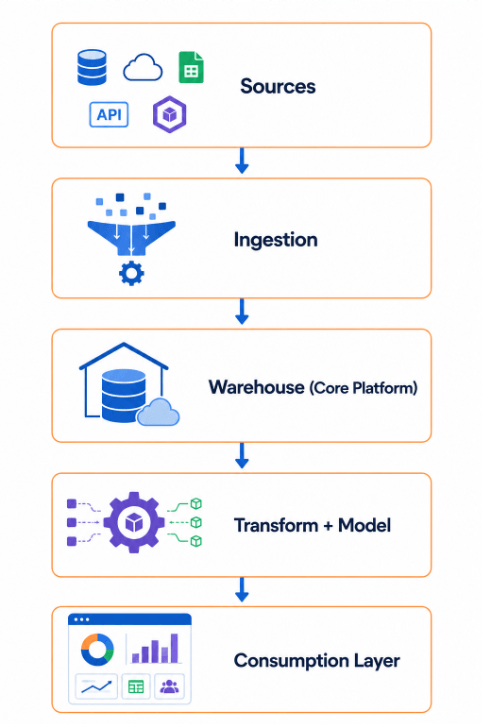
Fewer moving parts means:
- Easier debugging
- Faster onboarding
- Clear ownership
Complexity is no longer seen as sophistication.
It’s seen as risk.
2. The Warehouse Became the Center of Gravity
In earlier architectures, data constantly moved between systems.
Now, teams are reducing that movement.
Why?
Because every data transfer introduces:
- Latency
- Cost
- Failure risk
So instead of moving data around, teams are bringing compute to the data.
Transformations, aggregations, and even some application logic now live closer to the warehouse.
3. Data Modeling Became the Real Bottleneck
One of the biggest realizations in recent years:
Pipelines rarely fail because of infrastructure.
They fail because of poor data design.
In 2026, strong teams invest heavily in:
- Layered models (raw → curated → serving)
- Stable schemas
- Clearly defined metrics
A simplified model flow looks like this:
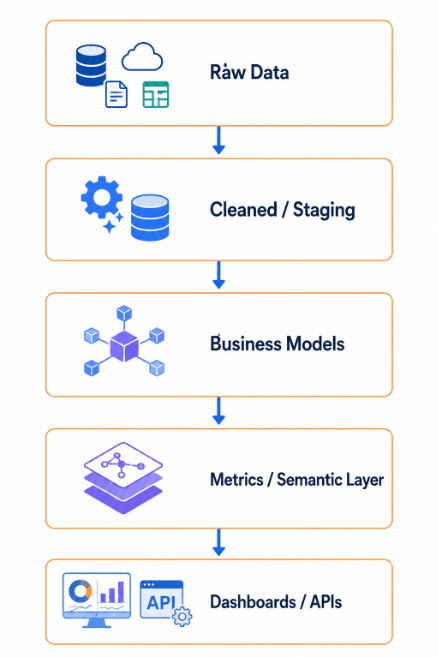
This is where clarity is created—or lost.
4. Observability Became Non-Negotiable
There was a time when teams found out about data issues from business users.
That no longer works.
Modern systems are expected to answer:
- What broke?
- When did it break?
- What was impacted?
A mature observability layer looks like this:
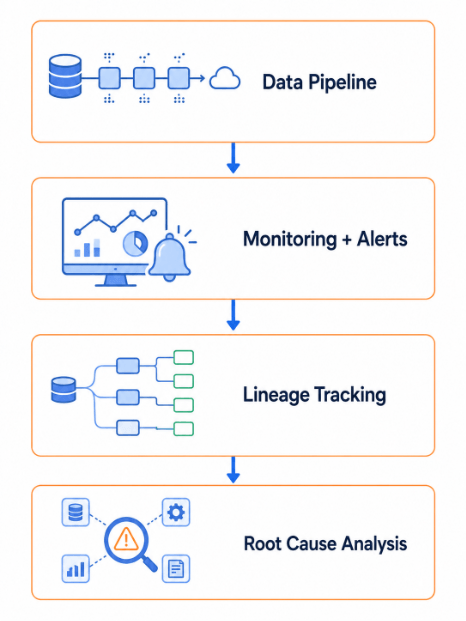
The shift is subtle but critical:
From “Is the pipeline running?”
To “Is the data reliable?”
5. Real-Time Found Its Place
Real-time is no longer the default aspiration.
It’s a targeted capability.
Batch → Stability, cost-efficiency
Streaming → Low-latency, event-driven use cases
The key is choosing intentionally—not reactively.
6. Governance Became Invisible (In a Good Way)
The most effective governance systems today are the ones you don’t notice.
They are:
- Embedded in pipelines
- Automatically enforced
- Version-controlled
Instead of slowing teams down, they provide guardrails that make scaling safer.
7. AI Didn’t Replace the Stack—It Exposed It
AI became a major force—but not in the way many expected.
It didn’t eliminate the need for data engineering.
It made it more important.
Because:
AI systems amplify the quality of your data.
Clean data → meaningful insights
Messy data → faster confusion
8. Cost Became a Design Constraint
In earlier years, cost was often an afterthought.
In 2026, it’s part of every architectural decision.
Teams now think in terms of:
- Cost per query
- Cost per pipeline
- Cost per insight
Efficiency is no longer optional—it’s expected.
The Real Evolution: From Stack to System
The biggest shift isn’t technical.
It’s conceptual.
We’ve moved from thinking about a stack of tools
to designing a system of responsibility
Where:
- Data has owners
- Quality is measurable
- Failures are visible
- Costs are understood
Final Thoughts
The modern data stack in 2026 is quieter than it used to be.
Less hype.
Fewer tools.
More intention.
The teams that are succeeding are not the ones chasing trends.
They’re the ones building systems that are:
- Understandable
- Reliable
- Aligned with real business needs
Because in the end, the goal was never to build a modern stack.
The goal was to build something that works.
What does your current stack look like—still evolving, or finally stabilizing?
Looking to simplify your data architecture? Connect with our team today.